

While there are several things that may contribute to a stalled labor, one sneaky one that doesn’t get talked about often is your ability, or really inability, to find internal rotation in your hips. Internal rotation is essential for helping your baby descend and rotate smoothly through your pelvis and birth canal; when we can’t find internal rotation, it can potentially cause a sort of mechanical “roadblock” that prevents your baby from moving and therefore labor from progressing.
Let’s take a look at what the heck internal rotation even means, how it influences your labor, and what you can do right now to support hip mobility for labor and birth!
What the heck does Internal Rotation (IR) mean?
In nerdy technical terms, it means moving towards the midline.
When it comes to your hips, when you’re internally rotated, the space between your inner thigh and crotch essentially gets smaller. We can achieve IR two ways:
1. Internally rotating your femurs in their hip sockets
- Stand with your feet pointing straight ahead
- Now, try to move your upper thigh bone and knees inward towards each other, without shifting your feet
2. Internally rotating your pelvis on top of your femurs:
- Stand with your feet pointing straight ahead
- Bend your left knee and lift that heel off the floor
- Without moving your right thigh, twist your hips towards the right (your left knee will come forward slightly)
Why is IR important for labor?
IR creates more space in the bottom of your pelvis, or your pelvic outlet. The larger the diameter of your pelvic outlet, the more space baby has to move through.
When your pelvic outlet is constricted, he/she will have a harder time descending, creating a longer active phase and/or pushing stage of labor.
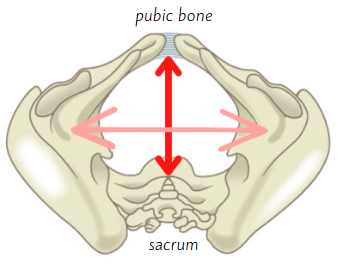
Sounds important, right? So how do you do it?
Before I show you a couple ways to achieve IR, I want to point out 2 things:
- The standard pushing position at most hospitals actually closes your pelvic outlet 😬😨🙊
Laying flat on your back with your knees shoved up towards your shoulders puts you in external rotation, which opens the top of your pelvis, but makes your pelvic outlet smaller! Why do they do it? Well, it’s typically the easiest position for them to manage you in, and it’s typically one of the “easier” pushing positions for you in terms of energy use.
- You can achieve IR even if you have an epidural.
Your care team, doula, and/or partner can help move your legs and/or you can use the peanut ball, if your team is willing to work with you on this. So, this is something you’ll definitely want to discuss with your care team if you plan on using an epidural. (not every care team wants to do these things)
Alright, let’s get into it. Below are 4 ways you can practice getting your hips into internal rotation. Practicing them now will “teach” your body how to get into IR; you don’t want the first time you ever attempt to move your hips this way to be in the throw of labor.
1. Standing Hip Shifts
- Stand with one foot elevated on a yoga block or stack of books.
- Shift your weight onto the elevated foot, especially your big toe.
- Keeping that knee (and whole femur bone) pointing straight (aka don’t move it), reach your opposite hand down and across
- rotate your belly towards your elevated thigh
- your inner thighs should move towards one another
- your pelvis should twist slightly
- hold for a few deep breaths
Bonus: hip shifts also move your tailbone towards the opposite side, which can also stretch your posterior pelvic floor 🙌
2. 90/90 (Shin Box)
- Sit with your feet flat just wider than your hips, knees to the ceiling, and hands on the floor behind you
- Anchor your right butt cheek into the floor and let both knees drop over to the left
- Hold for 5 seconds, then slowly rainbow your knees up and over to the right, keeping your left butt cheek on the floor
- Optional: allow your butt to come off the floor, knees all the way to the ground, and add a side body stretch, leaning to the side of your back leg
Bonus: shin boxes or 90/90 puts one leg into IR and the other into external rotation (ER). When your legs are doing opposite movements, you’re creating more space in your mid-pelvis which will help your baby rotate!
3. IR in Quadruped – knees in ankles out
- Come onto all 4s with your hands under shoulders and knees under hips
- Moving from your hips sockets (not your knees), shift your shins and feet out wide
- Hold for 5-10 seconds, then rotate back to parallel
- Optional: when your feet are wide, add a slight rock back towards your heels to help open the back of your pelvic floor
Bonus: all 4s is a common pushing position, so if you choose to push from here, knock those knees in, ankles out to make even more room in your pelvic outlet
4. Deadlift with IR
- Stand with your feet hip-width apart
- Without actually moving your feet, put pressure on your outer heels like you were trying to pull the floor apart between your feet
- Hold that outward pressure and hinge at your hips, pressing your butt back, sliding your hands down your thighs
- Option: do the deadlift hinge without the IR intention at your heels
Bonus: hinge-type movements help open the pelvic outlet more by moving your sitz bones (the bony part of your booty) apart and your sacrum out of the way!
Internal rotation helps your pelvis create the space needed for your baby to descend, while hinging movements open your pelvic outlet, making it easier for your baby to pass through. When these movements are limited or tight, they can contribute to labor stalls or complications. That’s why it’s crucial to practice both hip mobility and pelvic opening techniques throughout your pregnancy. Incorporating exercises and stretches that encourage internal hip rotation and pelvic movement can help you prepare your body for the dynamic changes of labor, promoting better outcomes and a more empowered birth experience. Practice these throughout your pregnancy doing as many reps as you feel comfortable – there’s no “right” number of reps or sets – just practice so your body knows how to move into IR.
Want more? Check out my guide, Opening your Pelvis for Birth for more pelvic outlet goodness PLUS information and exercises to help open your pelvic inlet and mid-pelvis!
