
If you’ve been waddling around with a sore back or struggling to lift your baby without pain, it’s time you meet one of your body’s secret weapons – your Posterior Oblique Sling.
This little-known system plays a massive role in keeping your pelvic stability and core strength in check. Think of it as your body’s built-in suspension system, keeping you grounded even when you feel like your body is doing its own thing.
Whether you’re lifting your baby with one arm or chasing after your toddler, your POS is hard at work in the background, providing pelvic stability and core strength when you need it most.
Your Posterior Oblique What?
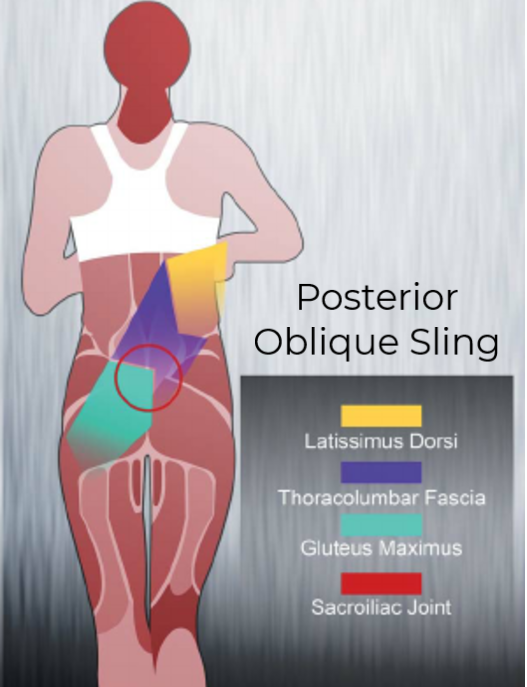
Your Posterior Oblique Slings (or POS’) are part of your body’s fascial system—basically, the web of connective tissue that links muscles and joints throughout the body.
This specific sling connects your latissimus dorsi (back muscles) on one side of your body to your gluteus maximus on the opposite side. Imagine a diagonal line running from the back of one shoulder to your opposite hip, crossing over your SI joints. So you have one per side!
Here’s the thing – pregnancy and postpartum put a lot of strain on your pelvis and core. Your body’s literally stretching, shifting, and adjusting to accommodate a tiny human (or two) and a whole new post-baby reality.
Your POS’ are super important because as your pelvis shifts and your center of gravity moves, it’s this sling that helps maintain pelvic alignment, provide stability to your pelvis, support your core, and stabilize your lower back. They help transfer force from upper to lower body, something you’ll need to safely lift your baby, maneuver their GD stroller into the car, and chase after your kids as they grow.
When your POS’ are strong, your pelvis stays aligned, your back feels better, and you’ll have a little more control over your core and movements. Who doesn’t want that?
4 Exercises to Strengthen the Posterior Oblique Sling (video demo below)
Ready to activate the Posterior Oblique Sling and support your pelvic stability and core strength? Here are four exercises to include in your workout routine whether you’re looking to combat pregnancy pelvic shifts or get back into a fitness routine postpartum:
Lunge with Band Row
- Grab a band or cable with your right hand and step your right foot back into a lunge
- As you rise, press through your left heel and row your right arm backward, engaging your right lat and left glute
Step Up with Row
- Grab a band or cable with your right hand and stand behind a step-up block
- Step your left foot onto the block and hinge at your hips, feeling a stretch in your left glute
- Press through your left heel to stand up, as you row your right arm backward, working your right lat and left glute
(Banded) Kickback with Row
- Place a loop band around your ankles and hold a DB in your right hand (you can do this body weight, with a loop band, or ankle weight)
- Hinge slightly at your hips and hold onto something with your left hand
- Lift your left leg behind you, keeping your leg straight, as you row your right elbow to the ceiling
Bridge with Pullover
- Lie on your back with your heels under your knees and hold a dumbbell in both hands
- Engage your core and reach your arms behind you, lengthening your lats
- Exhale and arc the weight up, pulling from the area under your bra, while lifting your hips into a bridge as you squeeze your glutes. This hits both POS at the same time!
Ready to see these exercises in action? Check out the video below!
Final Thoughts
Your Posterior Oblique Slings play a huge role in maintaining pelvic stability and strengthening your core during pregnancy and postpartum. By adding these exercises to your routine, you’ll build a more functional, stable core that’ll help you manage life as a mom—without that dreaded back pain.
Remember to listen to your body and modify exercises as needed. If you’re unsure of where to start, don’t hesitate to reach out for guidance. You’ve got this!