
If You Do Single-Leg Exercises — Lifting or Cardio — Don’t Sleep on This Muscle System
Struggle with balance during lunges, single-leg deadlifts, or running?
Notice one side feels weaker, or that your hip drops or shifts with every step or rep?
That’s your lateral sling (or lack thereof) talking.
Your lateral slings (one on each side) are key muscle systems that stabilize your pelvis and spine every time you step, shift, or balance on one leg.
If you’re experiencing:
⚠️ Hip pain, SI joint discomfort, or pubic symphysis pain
⚠️ Wobbly lunges, unstable step-ups, or struggling to balance in single-leg movements
⚠️ Low back tightness, especially during or after workouts
…then your lateral sling likely needs some serious attention.
Below I’m diving into:
✅ What the lateral sling is and why it’s essential for moms
✅ What happens when it’s weak
✅ How to strengthen it so your body moves and performs better
✅ 10 Powerful exercises to build lateral stability
What Is the Lateral Sling & Why Does It Matter for Pain and Instability?
Your lateral sling system is a connection of muscles and connective tissues that controls stability and coordination during single-leg and side-to-side movements (think running, lunging, step-ups, stairs, even just regular ol’ walking).
This system stabilizes your pelvis and lower back by connecting key muscles on the outside of the hip to the inside of the thigh, helping your body absorb impact, transfer force efficiently, and maintain balance.
The lateral sling includes:
✔️ Gluteus Medius & Minimus – Outer hip muscles that stabilize your pelvis during single-leg movements and are responsible for hip abduction (moving your leg away from your midline)
✔️ Tensor Fasciae Latae (TFL) – Assists your glutes in pelvic control and connects to the IT band.
✔️ Iliotibial Band (IT Band) – A thick band of connective tissue that runs down the outside of your thigh and helps transmit force from your hips to your lower leg.
✔️ Adductors (especially Adductor Longus) – Your inner thigh muscles that work with the muscles above to balance the forces on your pelvis.
✔️ Contralateral Quadratus Lumborum (QL) – A deep lower back stabilizer on the opposite side of your body that controls side-to-side balance.
You have a lateral sling on each side of your body.

How Weak Lateral Sling Muscles Lead to Pelvic Instability (and Even Knee Pain!)
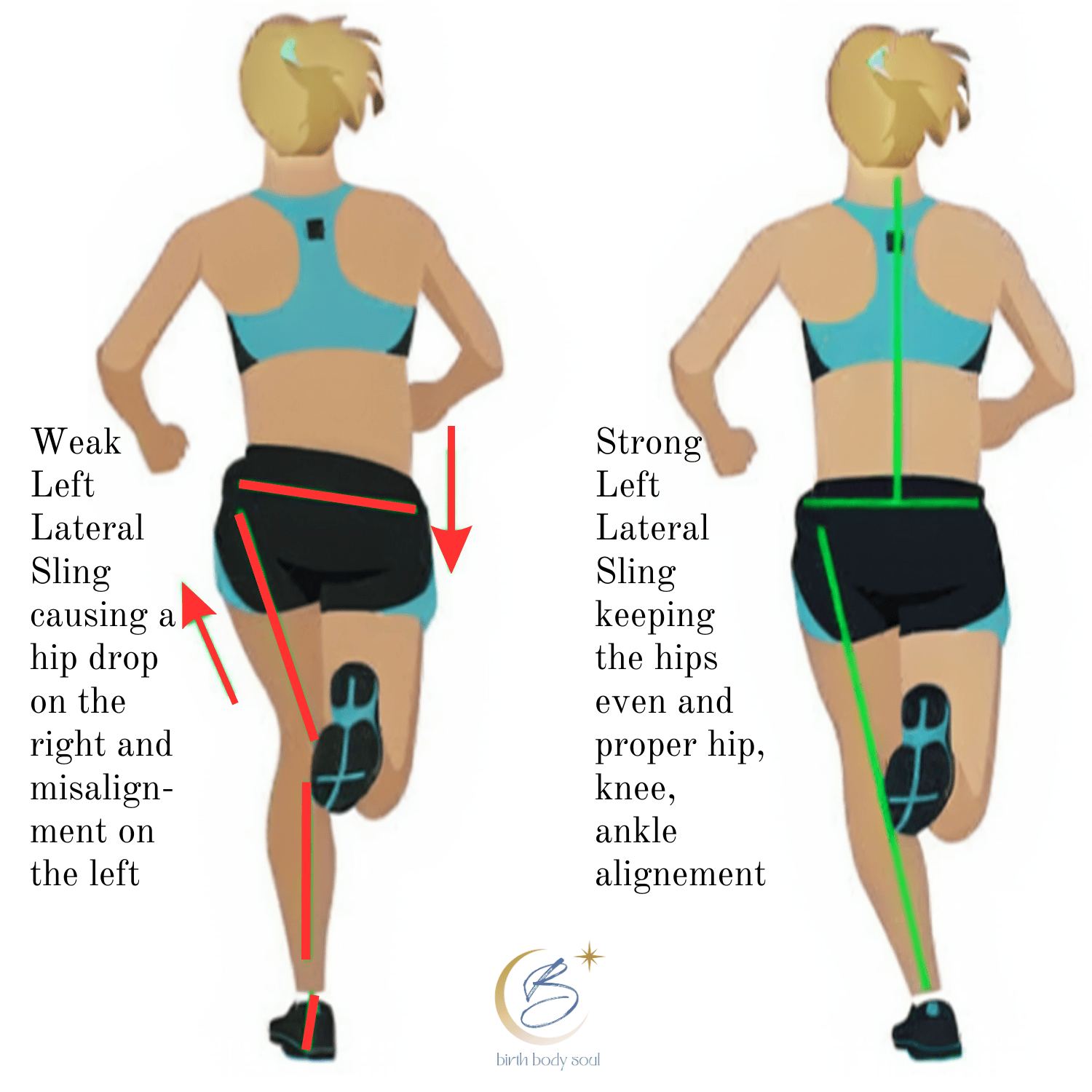
Your lateral sling keeps your pelvis level and your hips stable when you’re on one leg—which happens every single step you take while walking, running, or lunging. But when this system is weak? Things start to collapse… literally.
➡️ Pelvic Drop & Hip Instability
Instead of keeping your pelvis steady, weak glutes, TFL, adductors, and QL cause the opposite hip to drop when that leg is in the air. This creates that noticeable hip dip or excessive sway you might see or feel when running or doing any single leg exercise.
➡️ Hip Instability = Knee Pain & Unstable Ankles
When your hip isn’t stable, your knee compensates—leading to extra stress and potential pain. Without enough strength and support from above, you could be setting the stage for common knee issues like:
🚩 Runner’s Knee
🚩 IT Band Syndrome
🚩 Increased ACL & ligament strains
And then!! If your knee collapses inward, your ankle alignment gets thrown off, which can lead to:
⚡ Shin splints
⚡ Increased strain on the ankle
⚡ Plantar fasciitis
⚡ Foot pain from your arch collapsing in
Why Is Strengthening the Lateral Sling Important for Pregnancy & Postpartum?
A growing belly shifts your center of gravity, already increasing the load on your hips, knees, and pelvic joints. Postpartum, your body doesn’t automatically regain stability and has to adapt to new demands (like doing everything one-sided, baby-wearing, and toddler-chasing).
If your lateral sling isn’t strong enough to support these pregnancy changes and postpartum demands, you’re more likely to experience:
⚠️ Hip & SI joint pain from instability in the pelvis
⚠️ Pubic symphysis pain from excess strain on the front of the pelvis
⚠️ Lower back discomfort (because your body is compensating for a lack of pelvic support)
⚠️ Pelvic floor tension & dysfunction due to imbalances in muscle activation
⚠️ Flattening feet from more inward force on the knee and ankle joint
So yeah, rebuilding lateral stability is essential for pain-free movement and mom life.
10 Lateral Sling Strengthening Exercises
The best way to train your lateral sling is through single-leg and lateral movements—because that’s how this system works in real life.
Strengthening the glute medius, adductors, QL, and core stabilizers with exercises like step-ups, lateral band walks, and suitcase carries helps keep your pelvis stable, reduce knee strain, and improve overall movement efficiency.
Below is a list of the best exercises to build a rock-solid lateral sling and under that is this week’s VLOG where I show you how to do them all! Let’s get into it 💪
1. Isometric Hold
🔥 Why: Builds endurance in the glute medius, adductors, and core stabilizers to improve pelvic stability and balance in single-leg movements.
✅ How: Stand 6 inches from a wall, bend the knee closest to the wall to 90 degrees, and press it firmly into the wall while engaging the opposite glute to keep your hips even across. Hold for 20-30 seconds per side.
2. Standing Hip Dips
🔥 Why: Strengthens the glute medius & QL to prevent hip drop, knee collapse, and ankle instability
✅ How: Stand on the edge of a step or workout block, letting one foot hover off. Drop the hanging hip down, keeping the standing leg straight, then lift back up.
3. Lateral Band Walks
🔥 Why: Strengthens the glutes & outer hips to improve stability.
✅ How: Place a band above (easier) or below (harder) your knees. Step one foot out, resisting movement with the lag leg, before stepping that foot in, keeping tension in the band.
4. Banded Clamshells
🔥 Why: Strengthens glutes, adductors, and deep core stabilizers.
✅ How: Lie on your side, knees bent, feet together. Keeping a slight lean toward the floor with your top shoulder, and hip, reach the top knee forward then up and open, closing the knee with control.
5. Single-Leg Deadlifts
🔥 Why: Trains balance, core control, & glute activation in a functional way.
✅ How: With both hips facing the floor, hold a DB in the opposite* hand of your working leg. Extend the other leg back and as you hinge at the hips, keep your core engaged, and allow that leg to come off the ground.
*holding the DB in the opposite hand will work more of your glute med. Holding it on the same side works more inner thigh. If one feels super hard and awkward…it means you probably need to do it more 😬😬
6. Side-Lying Hip Abduction
🔥 Why: Activates the glute medius & core stabilizers.
✅ How: Lie on your side, engage your core, flex your top foot, and lift your top leg to just above body height, without rocking backward. Think about reaching the leg as far away from you as you can, not as high as you can. Lower to touch the floor.
7. Modified Side Plank with Hip Abduction
🔥 Why: Strengthens the glute medius, QL, and obliques to improve core and hip stability for better single-leg control.
✅ How: Get into a modified side plank (bottom knee and forearm on the floor). Lift hips, then raise the top leg until it’s in line with your body. Hold for 10 seconds, then lower with control.
8. Side Plank with Hip Dips
🔥 Why: Works the obliques, QL, and glute stabilizers in one go.
✅ How: Hold a side plank, whether from knees or toes, then slowly lower and lift your hips.
9. Lateral Step-Ups
🔥 Why: Targets the glutes, adductors, & core stability.
✅ How: Stand next to a box or bench, then step sideways onto it, engaging your glutes to lift up, keeping pressure in your entire foot, not just your heel. Emphasize a slow lower phase back to the floor.
10. Crossover Step-Ups
🔥 Why: Adds rotation & lateral control—key for running & single-leg strength.
✅ How: Stand next to a box or bench, then step diagonally across your body onto a box, driving through your glute, bringing your lag leg to come up next to your lead one.
BONUS: Suitcase Carry
🔥 Why: Challenges core, hip, and lateral stability dynamically.
✅ How: Hold a heavy weight in one hand and walk without leaning to one side.
Want to check them all out in real-time? Check out the VLOG below.
Struggling with Single-Leg Balance, Strength, or Pain? Let’s Fix That.
💡 Watch the VLOG – In the VLOG above I demonstrate all these exercises so you can see exactly how to do them.
📩 DM Me – Not sure if your lateral sling is weak? Let’s chat about what’s going on.
📞 Let’s Build a Plan – Hop on a call to build a training plan that gets you feeling strong, stable, and pain-free.
Final Thoughts on Training the Lateral Sling
If you’re lifting, lunging, or running—and especially if you’re pregnant or postpartum—you NEED a strong lateral sling.
The stronger & more stable this muscle system is, the better your movements feel, the more power you create, and the less pain you experience.
So next time you do a single-leg movement—pay attention. Is your lateral sling firing, or are you wobbling through it? If it’s the latter, let’s work on that. 💪