

One Sneaky Reason Your Lower Belly Sticks Out
If you grew up in the 90s or early 2000s, you’ve likely pulled your belly button to your spine a time or two (or 2 million).
This is also a common cue in the fitness world, but here’s the problem with pulling your belly button in…
Your core is made up of 4 muscles – your deep transverse abdominis, your internal and external obliques, and your rectus abdominis (6-pack muscle) – and they should all work together to support and stabilize your torso.
But when you pull your belly button in, you also tend to overgrip your upper abs (think between middle of your core to your ribcage) and the rest of your core is less active.
At first, it might feel like you’re “engaging your core,” but gripping through your upper abs can actually create a cascade of problems… including some you wouldn’t expect.
Note: if you’ve had an injury, suffer from chronic pain (low back, stomach, menstrual), or have an anxiety disorder, you may also grip to create “safety” or bracing within your system.
So let’s break down how it shows up in your body, and why letting it hang might be the best thing for you.
What Is Upper Ab Gripping?
Upper ab gripping is when you overuse your upper abdominal muscles (especially the rectus abdominis) to create tension and control or in an effort to make your core look smaller. And honestly, it may even just be a subconscious habit at this point.
The most visual signs are:
- Flattening or tightening of the upper belly while the lower belly pushes out, creating a “pooch”
- A crease across the middle of your belly right at or near your belly button
- Your belly button is turned slightly upward
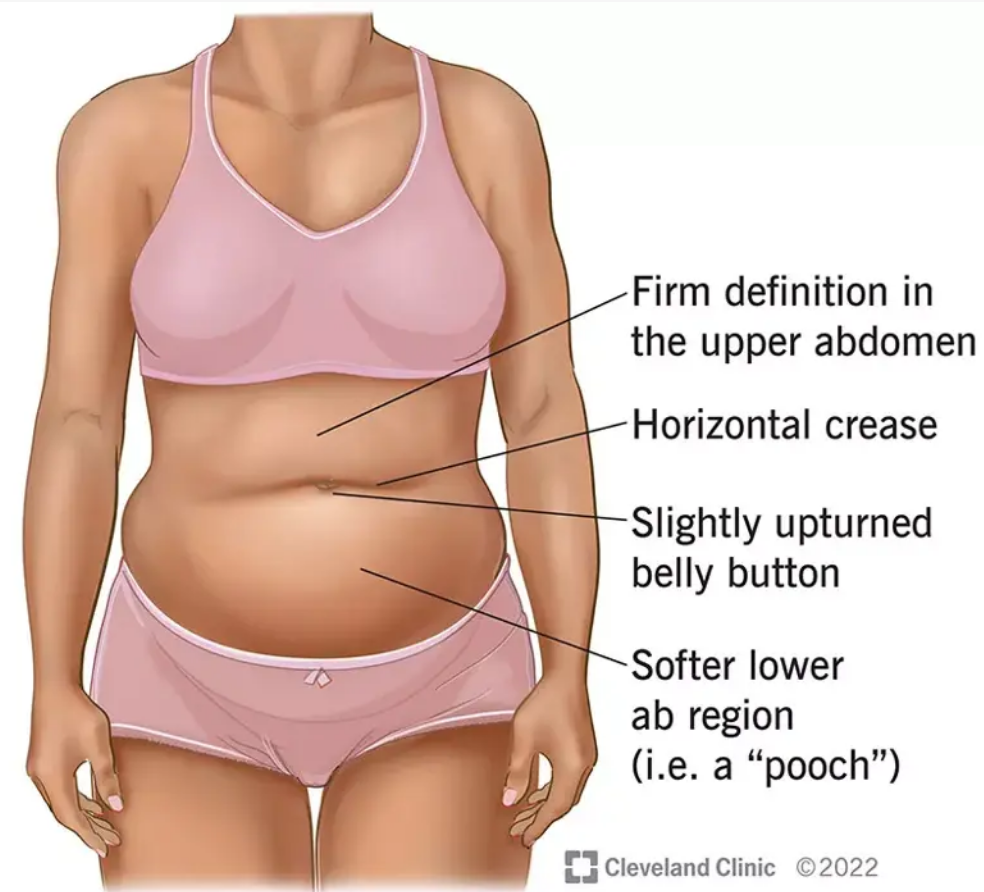
And while those are the most visible signs, upper ab gripping can also cause symptoms throughout your whole body—sometimes in places you wouldn’t expect.
Sneaking Symptoms of Gripping Your Upper Abs (like that belly pooch you can’t get rid of!)
1️⃣ Limited Diaphragm Function
When you grip your upper abs, there’s less room for your ribs to expand on inhalation, creating a tight, shallow breath pattern. You lose 360° rib expansion and therefore can’t coordinate your diaphragm with your pelvic floor, potentially creating other additional issues. You’ll also intake about 30% less oxygen with a shallow breathing pattern – one more thing adding to your fatigue 🙃.
2️⃣ Neck and Shoulder Tension
Gripping your abs disrupts natural breathing mechanics. Your diaphragm gets restricted, so you compensate by breathing with your chest, neck, and shoulders—hello, tension headaches and stiff traps. In addition, gripping pulls on your ribs, causing your head to shift forward making your neck muscles work harder to control your head in a less than ideal posture.
3️⃣ Low Back Pain
When your diaphragm doesn’t work properly, your lower back muscles have to work harder to help stabilize your torso. Chronic tightness in any muscle can cause pain. In addition, the incorrect use or engagement of your core muscles adds additional stress on the low back.
4️⃣ Lower Abdomen Weakness
When your upper abs dominate, your lower core can’t engage properly so it becomes weak and underused, which impacts the overall strength and stability of your core. (Remember, the 4 ab muscles are supposed to work with one another)
5️⃣ Impedes Diastasis Recti Healing
Going hand in hand with lower abdominal weakness, this increased pressure can press out on your linea alba, making it more difficult for your abominable muscles to move back towards one another.
6️⃣ Pelvic Floor Dysfunction
Gripping changes how we manage pressure within our torso. Imagine squeezing the top of a balloon – the air inside presses down and out, putting more strain on the walls of the balloon there. Gripping your upper abs is like squeezing the top of the balloon; all that tension drives force down into your (lower belly pooch and) pelvic floor—leading to tightness, heaviness, leaking, or even prolapse symptoms.
Getting Rid of that Upper Ab Clench
✅ Step 1: Build awareness
Start noticing when you’re gripping. Is it when you’re stressed? Standing in front of a mirror? Holding your baby? Awareness is your first line of defense.
✅ Step 2: Practice 360° Breathing
Diaphragmatic breathing helps reconnect your core and pelvic floor. Aim for 360 of expansion – outwards at the ribs, back, and abdomen, and downwards into the pelvic floor. A great position to try this is in child’s pose allowing your abdomen to inflate towards your thighs — especially if it feels scary to “let go” of your abs in positions like all 4s or standing.
✅ Step 3: Mobilize Your Upper Abs
Try skin rolling: gently grab the skin just below your ribs, lift it slightly away from your body, and roll it between your fingers. Do this across your upper core as you breathe deeply. It helps soften gripping patterns and restores natural movement.
✅ Step 4: Learn to Engage Your Entire Core
Once you’ve released tension and connected to your breath, it’s time to learn how to engage your entire core. (PS – this starts with proper breathing!) Think of creating a gentle hug around your midsection on your exhale, instead of a brace, suck in, or clench. This intentional and gentle activation is the key to pressure management within your core.
✅ Step 5: Coordinate Breath with Movement
Now that your body knows how to properly engage your core, this step helps your core and pelvic floor turn on reflexively so you’re not defaulting to gripping, bearing down, or bracing. Inhale to prepare, exhale to initiate movement like lifting your kid, standing up, or just rolling out of bed.
If this sounds like you, you’re not alone! Becoming aware is the first step and now you have some tools to start releasing the tension in your upper abs so you can move, breathe, and look better.
And if you’re looking for personalized guidance to rebuild your core and feel strong again, my DMs are always open!