
The core is often thought of as just the abdominal muscles, but it’s so much more complex than that—especially for women going through pregnancy and postpartum recovery. To add a bit more complexity, your core is divided into the “inner core” and the general core. Your “inner core,” also called your intrinsic core, consists of the diaphragm, pelvic floor, deep abs, and multifidi. These muscles work together to provide stability, support, and facilitate movement. Your core as a whole includes these muscles, plus many others, like your glutes, hips, spinal muscles, lats, and more. Today, we’re going to focus specifically on your inner core.
During pregnancy, your inner core undergoes a complete transformation. As your baby grows, your abdominal muscles stretch and separate, your pelvis widens, and your diaphragm shifts upward. After giving birth, these changes don’t simply revert to their original state. Many women experience a sense of disconnection and weakness in the abdominal region, leading to common postpartum issues like diastasis recti, lower back pain, and pelvic floor dysfunction. Understanding what happens to your core and how to rebuild it after childbirth is key to healing and regaining strength postpartum.
Let’s take a deeper look at your inner core layers and how they’re affected during pregnancy and beyond:
Your Inner Core:
- Diaphragm (DPH) – The primary breathing muscle that sits under your ribs
- Pelvic Floor (PF) – The bottom of your core canister found within your pelvic bones
- Transverse Abdominis (TVA) – The deepest core muscle that acts as a corset around your torso
- Multifidi (MF) – Deep back muscles that stabilize your spine
These “anticipatory” muscles are supposed to work together and activate milliseconds before any type of movement to:

- Stabilize your torso,
- Aid in posture and balance, and
- Prepare for “larger” movements, like bending down to tie your shoes, pick up your baby, or do a 360° jump
When they’re untrained or placed at a disadvantage (as often happens during pregnancy), we become more at risk for pain and injury, such as diastasis recti, lower back pain, and pelvic floor dysfunction.
For example, many moms “throw out” their back doing simple tasks, like picking up a light object. This is because their inner core isn’t firing correctly to automatically contract and support the movement.
Understanding the Different Abdominal Muscle Layers:
Before we go any further, it’s important to clarify that there’s more than one type of abdominal muscle. In fact, we have three abdominal layers:
- Outermost Layer – Rectus Abdominis (RA), your six-pack abs.
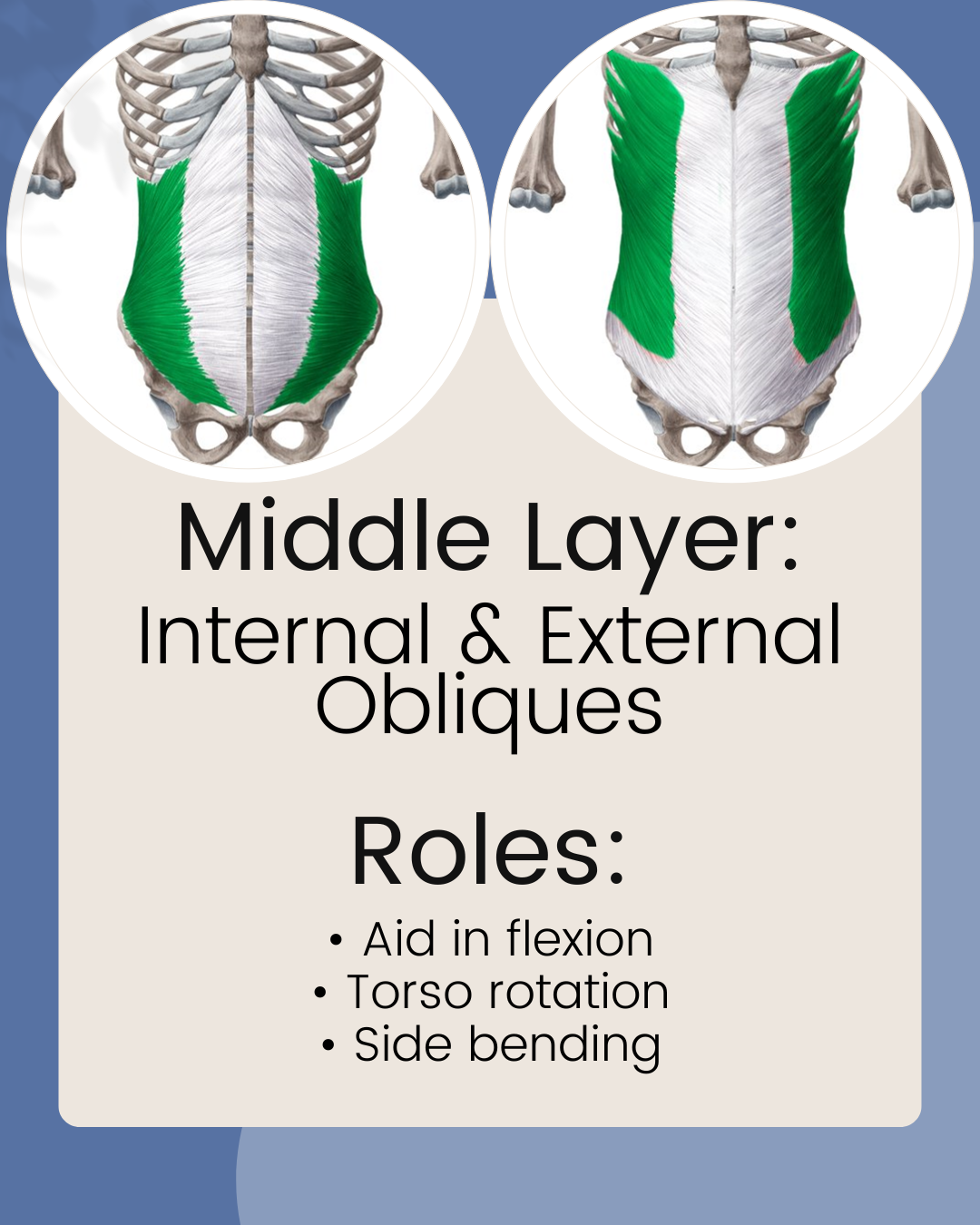
- Middle Layer – External Obliques (EO) and Internal Obliques (IO).
- Deepest Layer – Transverse Abdominis (TVA).
So while we’re focusing on the “inner core,” which includes the TVA, remember that your core as a whole also includes all three abdominal layers and many other muscles.


How Pregnancy Affects your Inner Core:
In the fitness world, most exercises target the RA and obliques, causing an imbalance in the ab layers, where most likely, your TVA is undertrained and weak. During pregnancy, your body undergoes changes that place your TVA at even more of a disadvantage.
As your baby grows, your diaphragm (DPH) is pushed upward into your ribs, limiting its range of motion. Since your diaphragm acts as the “pump” for your pelvic floor, TVA, and multifidi, its restricted movement reduces natural activation of these muscles. As a result, they weaken and are less able to anticipate movements, increasing your risk for pain and injury.
Additionally, the constant outward pressure of your growing baby against your TVA causes it to lengthen and slightly weaken over time, especially if you’re not actively engaging it during pregnancy.
What Happens Postpartum?
After your baby is born, it might seem like things should go back to normal, right? If only it were that simple!
For 9+ months, your baby grew inside your abdominal cavity, creating a type of pressure against all your core muscles called intra-abdominal pressure. Then, almost overnight:
- Your already weakened abdominal cavity becomes “empty,” leaving your inner core very unstable. Imagine an inflated balloon holding up walls—when it pops, those walls lose structural support. That’s a similar situation here
- Your diaphragm remains restricted, your TVA is still stretched out, and your pelvic floor might be in various states of healing or strain
- Your posture can get thrown off, causing compensatory muscles like your chest, shoulders, neck, and jaw to overwork as they try to stabilize your new wobbly torso
- You might find yourself holding and feeding your baby in awkward positions, further straining your posture and muscles
So, What Can You Do About It?
It’s crucial to work on your inner core strength during pregnancy to build a foundation that will support you in the postpartum period. A strong inner core helps create intra-abdominal pressure and reduces strain on compensatory muscles. Prenatal strengthening will prepare your inner core to function better postpartum, leading to improved posture, enhanced stability, and less discomfort.
Remember, your inner core is at the heart of your body’s stability and movement. While pregnancy and childbirth can challenge these muscles, the good news is that with mindful strengthening and rehabilitation, you can reconnect and rebuild. By understanding how these muscles work and taking proactive steps to build and then restore their function, you’re not just improving your strength and posture—you’re enhancing your overall well-being. Whether you’re looking to alleviate postpartum discomfort, return to fitness, or simply feel more supported in your daily activities, prioritizing your inner core health is key. Take it one step at a time, listen to your body, and don’t hesitate to seek professional guidance if needed. You’ve got this, mama!
To learn more about the importance of your inner core before returning to running, CrossFit, or other types of “impact” workouts after having your baby, check out this blog post.
And if you’d like to learn *how* to strengthen your inner core, You can book a *free* 10-minute call with me here!