
5 Red Flags Your Postpartum Workouts Are Moving Too Fast for Your Core & Pelvic Floor
Feeling More Wrecked Than Refreshed After a Workout? Let’s Talk.
Getting back into fitness postpartum can feel like a game of trial and error. You want to rebuild strength, feel like yourself again, and maybe even reclaim your pre-baby workouts. But here’s the thing—more isn’t always better.
If you’re dealing with weird aches, unexpected leaking, or just feeling wrecked instead of refreshed after your workouts, these could be red flags that your postpartum workouts are exposing weakness, not building strength.
Not sure if you’re overdoing it? Stick around—I’m breaking down 5 red flags that could mean your postpartum workouts are asking too much of your body, especially your core and pelvic floor (and what to do instead).
Red Flag #1: You’re Leaking During or After Workouts
Yep, let’s start with the one no one wants to admit to—but if it’s happening, you’re not alone. If you’re peeing a little when you jump, run, or even just stand up after an exercise—it’s a sign your body isn’t fully ready for that movement yet.
💡 What’s Happening?
Leaking is often a sign of poor pressure management, meaning your core and pelvic floor aren’t handling the impact well. It doesn’t always mean your pelvic floor is weak — it could mean your system isn’t coordinating properly yet or your pelvic floor is actually too “tight.”
✅ What to Do Instead:
- Swap high-impact moves for low-impact versions (e.g., marches instead of jumping jacks, controlled step-ups instead of box jumps).
- Work on breath control—exhale on exertion to help manage intra-abdominal pressure.
- Check your alignment—stacking your ribs over your pelvis can make a huge difference.
- See a Pelvic Floor Physical Therapist to determine if the “issue” is muscle coordination, tightness, or weakness.
🚨 What NOT to Do:
- Just do more Kegels. (Leaking doesn’t always mean weakness—it can also (and often does) mean tension!) Check out what happens to your PF if all you do is kegel here!
- Ignore it and keep pushing. (Leaking is common, but not normal in postpartum fitness.)
Red Flag #2: You’re Feeling Heaviness or Pressure in Your Pelvis
If you feel like there’s something “down there”—like heaviness, bulging, or even a dragging sensation—you might be dealing with pelvic organ prolapse (POP) or general pelvic floor dysfunction.
💡 What’s Happening?
Your pelvic floor and core need time to regain strength and coordination postpartum. If they’re not fully supported, certain movements (especially high-impact or heavy lifting) can put too much strain on your pelvic floor.
✅ What to Do Instead:
- Focus on postural alignment and breathwork before adding heavy loads.
- Strengthen your glutes, inner thighs, and deep core muscles (because your pelvic floor doesn’t work alone and when the surrounding muscles are strong, your PF can chill a little!).
- Try elevating movements (e.g., incline planks instead of floor planks) to reduce pressure.
- Read this blog post to learn how to release tension in other areas of your body to relieve prolapse symptoms
- See a Pelvic Floor Physical Therapist to learn exactly what your unique body needs.
🚨 What NOT to Do:
- Push through and hope it gets better. (It won’t. Give your body time and proper support!)
- Assume you just need to squeeze your pelvic floor harder. (A too-tight pelvic floor can make prolapse symptoms worse.)
Red Flag #3: Coning or Doming in Your Core
Take a look at your abs during workouts—if you see a ridge or bulging line down the center when you sit up, plank, or lift, that’s coning or doming. It’s a sign your core isn’t managing pressure well and your cue to check out my post on postpartum core recovery to learn how to rebuild core strength the right way.
💡 What’s Happening?
Your deep core muscles and linea alba (the connective tissue between your abs) are still recovering from pregnancy. You may have Diastasis Recti where coning = pressure escaping where your core is weakest.

✅ What to Do Instead:
- Modify movements to avoid excessive strain on your core (e.g., swap crunches for dead bugs or heel slides).
- Use breath work to engage your deep core before moving (exhale before exertion!).
- Strengthen your entire core system, including your glutes, lats, and pelvic floor—not just your abs.
🚨 What NOT to Do:
- Keep planking or doing sit-ups anyway. (It’s not about avoiding these forever—it’s about working your way back to them safely.)
- Assume you’ll “just heal over time” without adjusting how you train.
Red Flag #4: You’re Constantly Sore, Fatigued, or Drained
Postpartum fitness should make you feel better, not worse. If you’re sore for days, exhausted, or feeling totally depleted, you might be pushing too hard or not recovering well.
💡 What’s Happening?
Your body is still healing, and even if you feel good some days, your energy, hormones, and sleep (or lack thereof) impact recovery. Overdoing it can lead to chronic fatigue, increased stress, and even hormonal imbalances.
✅ What to Do Instead:
- Prioritize quality over quantity—shorter, effective workouts are better than long, draining ones.
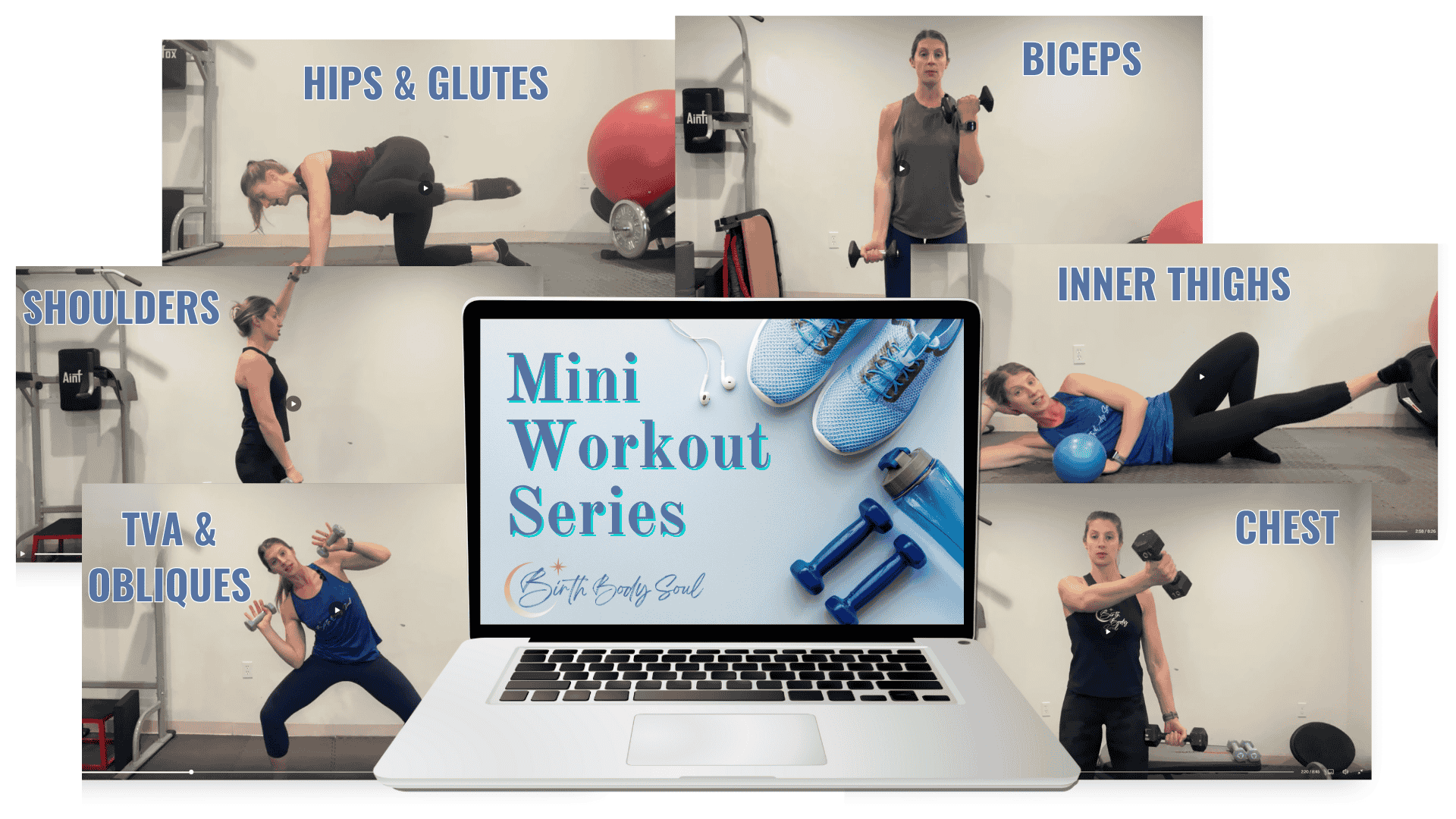
- My Mini Workout Series gives you quick, effective workouts designed for postpartum moms.
- Focus on progressive overload instead of “going hard” (slowly increase intensity over time).
- Eat enough protein, carbs, and healthy fats to support recovery.
🚨 What NOT to Do:
- Push through exhaustion because “moms just have to deal with it.” (You deserve better!)
- Assume more sweat = better results.
Red Flag #5: Pain That Feels “Off” (Not Just Muscle Soreness)
Post-workout soreness? Normal.
Sharp, deep, or persistent pain? A big red flag.
💡 What’s Happening?
Pain—especially in your pelvis, lower back, hips, or core—is often a sign of poor movement mechanics, muscle imbalances, or instability. Your body relies on muscular sling systems (groups of muscles that work together for stability) to absorb impact and keep your pelvis, core, and spine supported.
If one of these systems isn’t working well, your body compensates in ways that lead to pain, tightness, or recurring injuries.
✅ What to Do Instead:
- Pay attention to how your body feels during AND after workouts.
- Adjust your form, posture, and breathing mechanics before adding intensity.
- Consider working with a postpartum fitness specialist (hey, that’s me! 😉) to address pain before it becomes a bigger problem.
- Struggling with SI joint or pelvic pain? Your Deep Longitudinal Sling (DLS) plays a major role in stabilizing your pelvis and absorbing impact. When it’s weak, your low back, hips, and core take on extra stress—leading to pain and instability. Learn how to strengthen it here.
- Feeling weak or unstable in single-leg movements? Your Posterior Oblique Sling (POS) helps transfer force between your upper and lower body for better balance and core control. Read about it here.
- Noticing pain or weakness in twisting movements? Your Anterior Oblique Sling (AOS) connects your obliques, deep core, and inner thighs to create rotational stability. A weak AOS can contribute to pelvic pain, core instability, and even diastasis recti issues during movement. Learn how to activate and strengthen it here, especially if you’ve had a C-section!
🚨 What NOT to Do:
-
- Assume pain is just part of postpartum fitness. (Nope, definitely not a requirement.)
- Ignore it and keep pushing—especially if the pain lingers.
So… Are You Overdoing It? Here’s What to Do Next.
If any of these red flags sound familiar, don’t freak out. You don’t have to stop working out—but you DO need to listen to your body and make adjustments. Smart, strategic training > pushing through pain.
👉 Ready for workouts that actually support your recovery? Let’s make sure you’re building strength—not pain and frustration.
💬 Slide into my DMs – Not sure where to start? I’ll help you figure out the best next step for your postpartum recovery!
📞 Book a Call with Me – Let’s chat about your postpartum training plan, pelvic pain, or any concerns you have.